
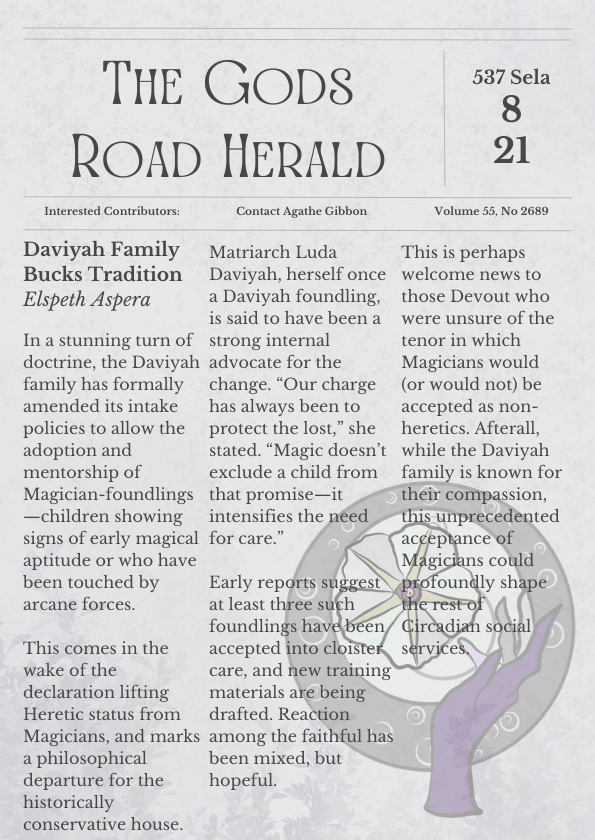
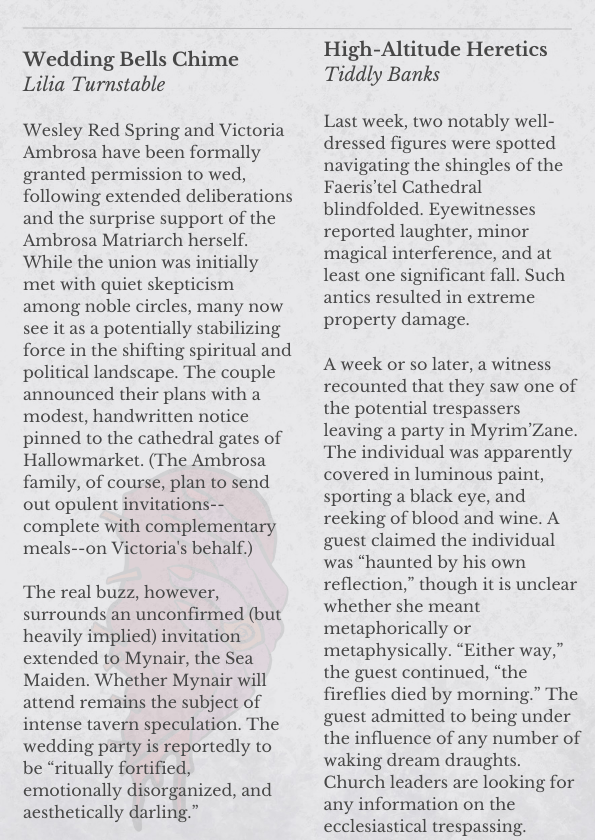

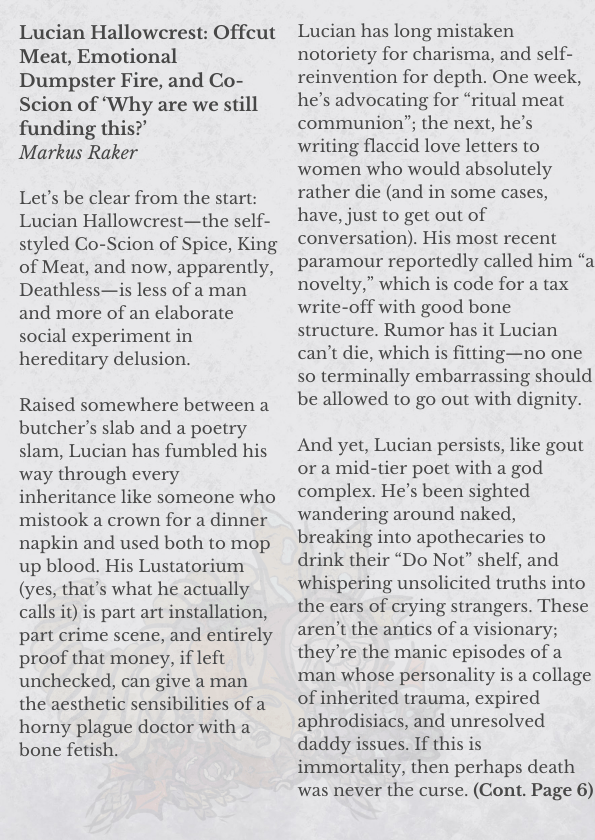
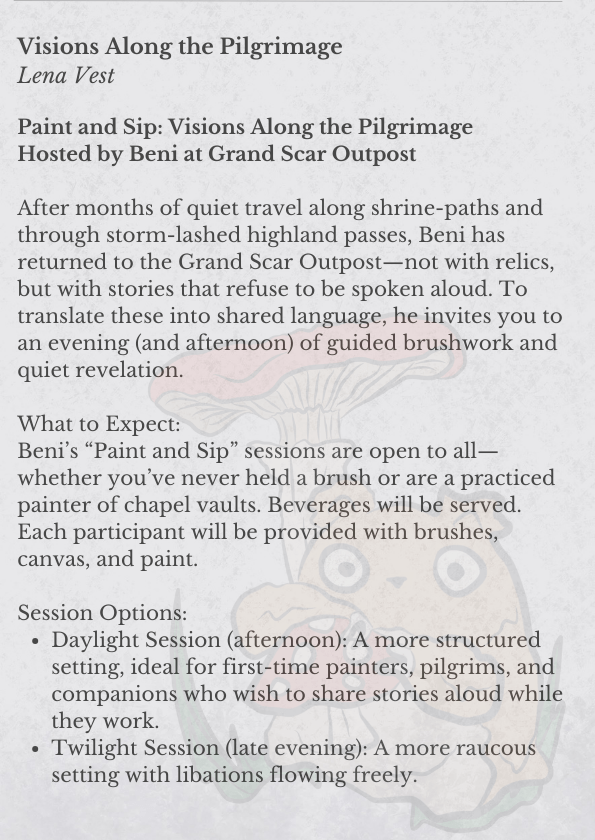

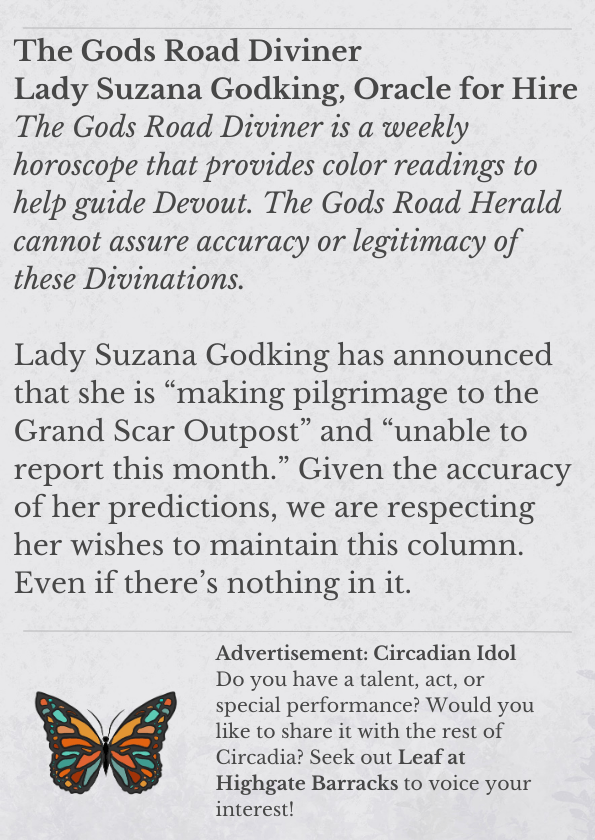
Below is the Gods Road Herald for Event 9 of Zealot Larp. Copies will be printed out and available on site.
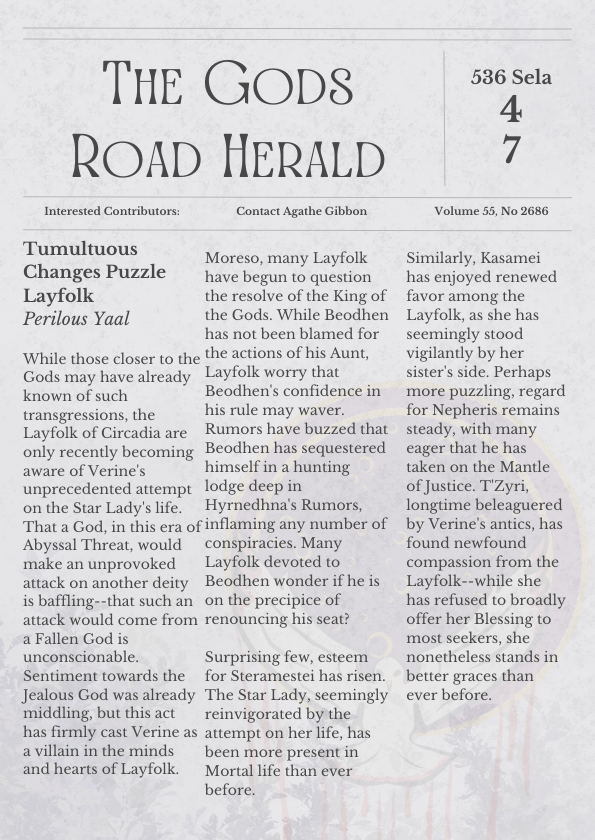


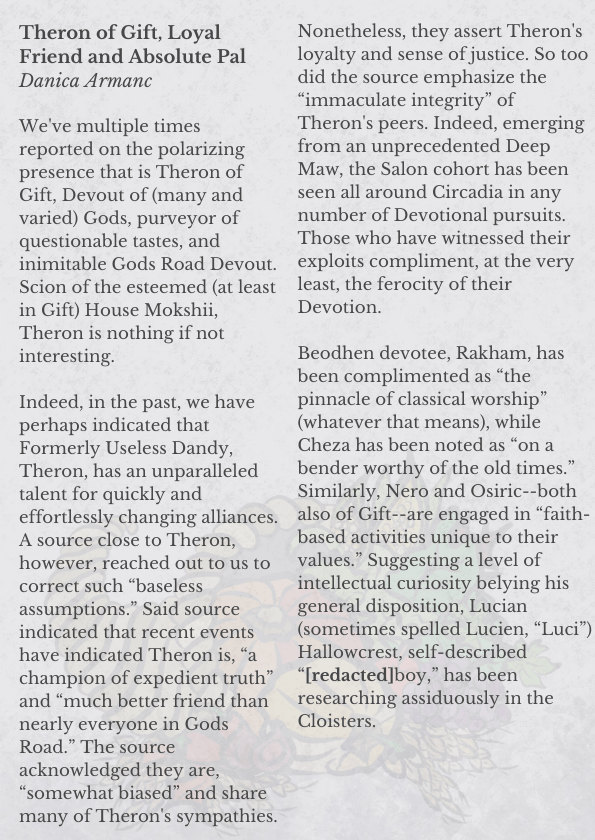

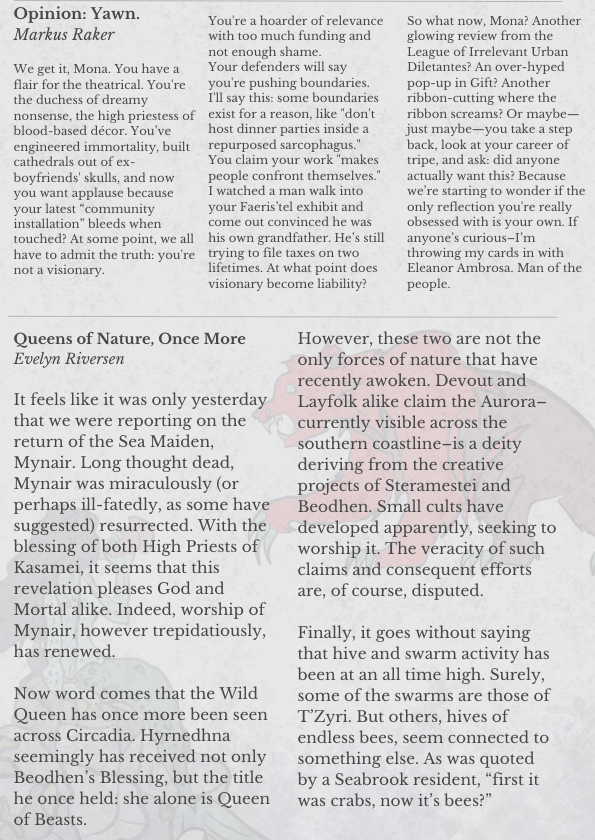

Due to in-game actions, the Minor God Ca’ri’kara is now available to follow!
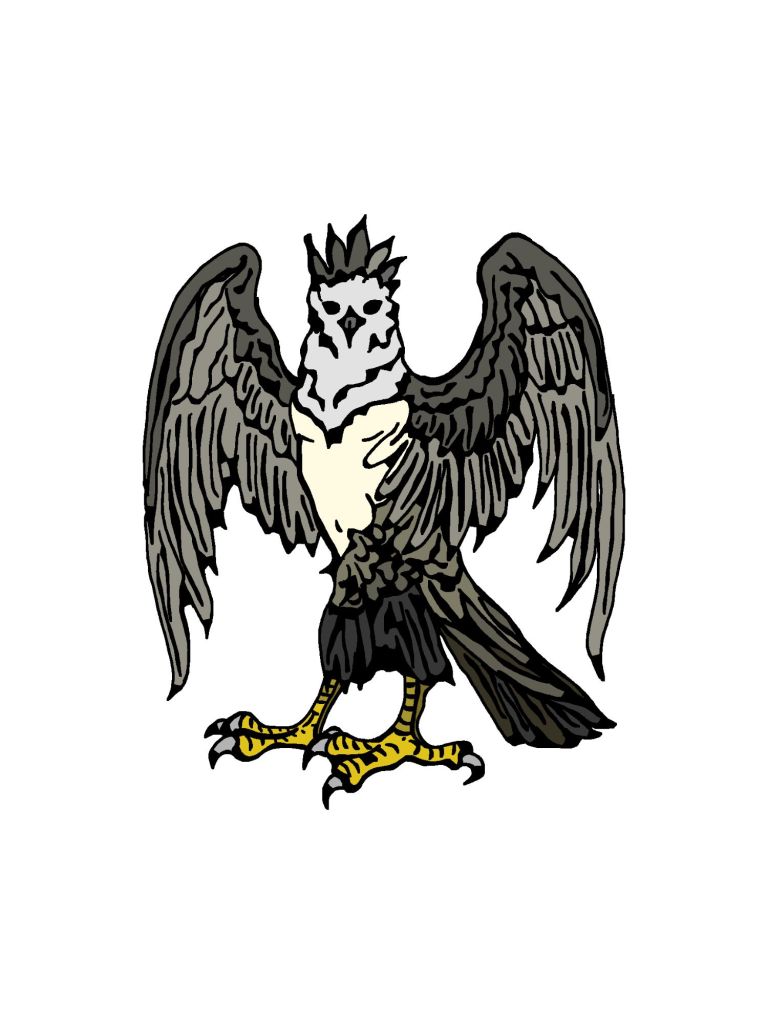
Read more about Ca’ri’kara here.
The following skills have been added to the rulebook and are available for Ca’ri’kara Devout.
The Corpse-eater
All followers of Ca’ri’kara have the Trait: Scavenger.
Power Minds
CP 3
You have 1 additional Earth Attribute.
Spreads His Wings
CP 3
You have access to the schools of Blood and Nature.
An account of T’Rer’s Reign as King of the Gods, Second Pantheon, Commencing in the year 0 Sela, 265 Lyr, 2463 Ul. Recovered from the Cloisters on the 13th Day of the 4th Month in the Year 535 Sela.
When Faeris’lyr’s corpse fell, the earth shuddered and rumbled. For all who listened, the tremors sounded like a confused muttering of both applause and condemnation–for those who knew what lurked in the deepest of earth, it was unmistakably an unkind, appreciative laughter.
T’Zyri looked to her brother, T’Rer, in triumph and contempt. She had decided the First Blood War–a War she might have decided sooner had she been less patient.
Verine screamed, rushing to her brother’s corpse, and cursed The Schemer’s name. Quickly, T’Rer rebuked Verine but turned to his sister.
“What have you done, T’Zyri?”
T’Zyri narrowed her eyes and, acid dripping from her words, responded, “I have won the war.”
“I offered him a choice, sister. With honor, that choice was his to make.”
T’Zyri laughed, and disdain joined the rumblings of the earth around them. “War is no place for pageantry, brother.” She sighed deeply, knowing she would be understood but only imperfectly. “And what would happen? Yes, perhaps he would concede, and yet another child of the killer of Pel’pyri, Me’me’suul, and our parents’ legacy would remain to sully Mortal minds with allegiance to a name rather than a purview,” and T’Zyri cast a wicked look at Verine.
“You know he would have accepted trial by combat,” T’Rer interjected. “And he was frail.”
Once more, T’Zyri laughed. “Of course I knew he was frail. Or do you credit yourself with all victories?” As T’Zyri spoke, Beodhen looked up from where he tended to his weeping aunt. “Brother, Faeris’lyr was nevertheless a God and a strong one. Do not think yourself so mighty that you might not be toppled by an errant distraction.”
“He was weak, T’Zyri!” T’Rer began to lose his temper, and Beodhen quickly rushed to steady him.
“But if he was weak enough to win,” T’Zyri chided, “then my decision to assassinate a dying, feeble ruler might have instead been the far crueler massacre of all those who would support him.”
Nepheris quietly watched the two Gods argue. He felt no anger towards the Goddess who murdered his father. She was right, after all. Strategy ought only invite chance when there is no other option.
“Either way,” sparkled a voice from behind, “the war has been decided.” Steramestei, radiant even as she was spattered with Faeris’lyr’s blood, stepped forward.
“Yes,” Kasamei joined her twin. “And it is time to mourn the dead.”
“Mourn the dead. Celebrate the living,” Beodhen offered, “is it not the same?” Beodhen bent and picked up the golden crown that had fallen from his father’s head. He regarded it and looked to T’Zyri. “This is yours. You have decided the battle, even if unkindly.”
T’Zyri received the crown, her bloodied hands fingering the golden tines nervously. “Though he quarrels with me, this is for my brother and the Pantheon he would create in my parents’ image.”
T’Rer inhaled sharply, his temper still hot. “Keep the crown, sister. It is yours. But know you have no place on my Pantheon.”
And T’Rer named the Second Pantheon: Beodhen the Shining, Nepheris the Bound, Kasamei the Kind, Steramestei the Radiant, Mynair the Beautiful, and Hyrnedhna the Wild. And their ruler, of course, T’Rer the Righteous.
Such is the way of those who do not appreciate the creatures that walk in Shadow.
As King of the Gods and head of the Second Pantheon, T’Rer set to the work that he thought of most immediate importance: stabilizing and securing the world of the Mortals.
The First Blood War had taken the lives of Me’me’suul, Pel’Pyri, Myris’lyr, Beo’lyr, Pel’yra, Le’neris, and Faeris’lyr. While such losses were undoubtedly cataclysmic, Mortal casualties had been small in number. The brutal fights of the First Blood War had taken place mostly at the Horizon Line, and Mortals were but witnesses rather than active combatants.
T’Rer and his Pantheon, therefore, were set with a strange reality: many Mortals lived, but the Gods they had loved were dead and gone.
T’Rer sought first the counsel of Nepheris, Bound to the Gods as arbiter and facilitator. Regardless of his duties, Nepheris was the deity most aligned with the pulses and desires of Mortal life.
“My friend,” T’Rer asked the Prince of Contracts, “tell me what I might first do to secure the Mortal world?”
Nepheris thought secure was a strange choice of words–it meant many things, from tightening bonds between Gods and their followers to establishing Deific control over the domain. All things were possible, he affirmed, and relied on one thing first and foremost.
“My lord,” Nepheris responded. “You must first work to build trust with Mortals. Through trust all things might move.”
Nepheris thought on his father’s legacy. Faeris’lyr had loved the Mortal world, even going so far as to take a Mortal bride, [redacted]. For whatever he lacked in leadership of the Gods, Faeris’lyr was beloved among Mortals. Nepheris had observed his father and found his ease inimitable: truly, it seemed he was happier among the dying than when among his immortal peers.
However, Nepheris mused, his father had never been able to strengthen the bond between the Gods and Mortals. The pathway between the Pantheon and the believer–the true channel of Devotion–existed but, at least during Faeris’lyr’s Reign, never truly strengthened.
Nepheris explained this, in careful detail, to T’Rer: “My father failed to act as a God–however, the Mortals saw the Gods at their most fearsome. Now it is your job to embrace something most difficult: behave as a Mortal while maintaining your power as a Deity. From there, at least I believe, comes true allegiance between the Gods and those we serve.”
T’Rer thought on this and, moreover, on how similarly his sister might have responded.
Nepheris and T’Rer continued to collude and, as one might expect, given their purviews, settled on an agreed upon tactic: the establishment of law.
The First Blood War had distracted the Gods, and much of Circadia had become lawless and Wanton. T’Rer was truly sickened by such action, and he wanted to build order as he and his parents before him had built the first cities.
“Yes, I agree,” Nepheris counseled. “But as my brother might say, they need skin in the game. We can’t decree our will from on high. After all, they’ve seen us at our ugliest, our most brutal, and perhaps weakest. We die, we fight–”
“We betray,” T’Rer interrupted.
“We should go to them as colleagues. Invite them to the table. These are our laws between not just Mortals, but Mortals and Gods.”
Hearing this, T’Rer’s eyes took on a brief spark of passion. He began to speak on what such an accord might look like. It mounted into a speech on the eternal union of Mortal and God, hewn into stone and tree as immortal as the tides themselves.
Nepheris quietly chafed under such a suggestion, but his way was not to confront but instead to convince.
“Ironclad law that does not change may not be in our best interest,”Nepheris pondered. “If we as Gods can make mistakes, surely, in conversation with even the most Devout of the Mortals, we might falter.”
T’Rer stopped himself short and quickly nodded. “You are right, of course. In building a great wall, it is easy to ignore the weakest cornerstone.”
Nepheris continued, “And so might it not be better to establish our own foundation and, from this, offer the Mortals the chance to revise and build from it? And might we not, like tacticians do, learn from it over time?”
T’Rer followed this and, gradually, Nepheris led him to a most agreeable invention: the first ever Day of Negotiations.
Pleased with his tactical approach to the new King of the Pantheon, Nepheris gracefully moved into his next series of plans: Mortal cities where the Devout of the Realm and attending layfolk might congregate.
Faeris’lyr had started this early work, but both the war and his own lack of ambition had stalled progress. Indeed, some of the most promising cities had fallen to ruin.
T’Rer eagerly accepted such plans and set to work erecting his own capital: T’Zane. Named for his parents, the sprawling city was both strategic and austere. Monuments and civil works were meted equally by practical streets and rigid architecture. It pleased Beodhen and Steramestei little, but Nepheris conceded its stern grandeur.
Beodhen happily took on charge of Faeris’Tel, the former capital city and the first terrestrial home of the Dynasty. Similarly, Nepheris adopted Tel’Nephri as his own seat of power–though more modest than T’Zane and Faeris’Tel, it was his mother’s natal home and, in the Prince of Contracts’ eyes, had as much potential as any grand city.
Mynair requested the bustling urban port Port Naia–while Port Naia was a hub of maritime commerce and culture, Mynair stated she intended to spend most of her days far out to sea. Nevertheless, she would offer its inhabitants her Blessing.
To Hyrnedhna, Beodhen suggested no city be given. Instead, he determined that the great expanse of ancient wood be both named and provided to the Wild Queen. After all, it was both the place from where Gu’labir drew the earth that made Hyrnedhna and the site of Me’me’suul’s demise. Hyrnedhna begrudgingly appreciated the Shining Prince when he gave the many tracts of wood the name Suul’Nedhna.
Hyrnedhna, now possessing her own territory, assembled the wild creatures of earth that once followed Pel’pyri and Me’me’suul. Howling in the tongue of beasts, she named them her own: Hyrnedhnai.
Kasamei was granted the small town of Deathwalk. Somewhat surprised at its size, Kasamei requested from Nepheris funds to support its growth. Perhaps a bit chastened by his oversight, Nepheris quickly provided her with gold from his own coffers.
Steramestei claimed for herself the Brightwater Isles, quickly establishing monasteries for her worshippers. T’Rer questioned her decision to isolate from the other Gods, but she assured him she needed her privacy.
As an extension of diplomacy to the Fallen Gods, Nepheris offered territory to them as well. This somewhat bothered the King of Gods, but his silver-tongued ally assured him it was a pithy courtesy.
To Verine was provided Vyr’Vera, the lush and fertile expanse of sunny hills she had long known. Verine was delighted–it was a place where her Devout could live in discretion and success.
To Gu’labir was conceded the Me’guul Tunnels. Ancient and labyrinthine there were places that, despite Nepheris’s best efforts, only the Rotten One truly knew.
Opix accepted no territory, winking that they preferred to be without home.
And while she was only a Minor God, T’Zyri was nonetheless provided the ancient city of Myrim’Zane. Known only for its crumbling ruins and population of ill repute, Myrim’Zane nevertheless held a secret only T’Zyri knew: it was an unseeable font of true Mana, for reasons known only to her and perhaps Gu’labir. She decided she would bide her time, within the magical streets and alleys, and master the landscape around her.
Among all these cities, however, one place remained high above all others: Gods Road, the place where the Divine first met the Mundane and, ever since, the Extraordinary grew.
Steramestei and Kasamei applauded the works of the Prince of Contracts and King of Truth. However, behind closed doors they questioned the balance of power.
“I agree,” Kasamei started as she poured her sister a cup of tea, “that Mortals should be given a seat at the table.”
“Of course,” the Star Lady assented. “And who knows that better than us? After all, it is the two of us, Mynair, and Hyrnedhna who have most widely attracted the love of Mortals and their worship.”
“Yes,” Kasamei returned, “and you might go so far to say that, even with our fellows’ increased popularity, we are truly what strengthens the Pantheon.”
Steramestei sipped her tea and responded with feigned idleness. “Quite so. And then you must anticipate my worry, sister.”
Lady Death nodded. “Though they offer Mortals a seat at the proverbial table, and they offer Mortals law, I wonder if our own Devout are offered equal voice.”
Steramestei smiled a bit archly. “Even if they had the best of intentions, is it not in our nature to favor our own Devout?”
The Sisters chatted into the night and, with little effort, concocted a plan they thought might serve them best.
Though Kasamei did not commonly walk in the shadows of earth, she was nevertheless familiar with their shape. In accordance with her sister’s ideas, she journeyed deep into the dark, seeking the one who might know the King of Gods best: his sister, the Schemer.
T’Zyri slithered through walls and alleys as Kasamei ventured to her throne room. She found herself persistently frustrated that, try as she might, it was difficult to skulk at the heel of Lady Death.
When Kasamei entered the shadowy throne room, T’Zyri stepped forth. She was still elegant, Kasamei noted, but somewhat harder. When once she had dressed in the finery of Horizon, she now garbed herself in metal and silk–a queen armored for some unseen war. Still, T’Zyri wore her father’s crown, and at her hip was the dagger.
“Kasamei,” T’Zyri spared no pleasantries.
“I come seeking advice, Princess,” Kasamei offered courtesy.
“Yes, the swarms have told me. You and your sister are wary of my brother’s plans.”
Kasamei paused, considering her words. “Not so much his plans, but our own representation. Law, order, and truth are fine and good, but they make little space for change and revelation.”
T’Zyri smiled, and it was unkind. “Indeed, steel and silver may shine but not so brightly as the dimmest star.”
Kasamei remained silent.
T’Zyri shrugged and slouched in her throne. “I have always envied you, Kasamei,” she conceded. “I know most things, yet I do not know what lies beyond that final door.”
Kasamei smiled in turn. “Neither do I, Princess. I am merely a shepherd.”
T’Zyri regarded her, the webs of her mind minding their own corners. “So you say,” T’Zyri paused, though Lady Death was still. “In any event. You seek a balance of power that my brother might accept.”
“Yes, in so many words,” and Kasamei offered a sincere clarification, “truly, we want our Mortals represented, and their Devotion strengthened. Laws are fine, but not when they are made in isolation from the scope of faith.”
T’Zyri nodded and thought. She had no real interest in aiding the Sisters, but she had less interest in incidentally strengthening her brother’s Reign.
“My brother hungers for hierarchy as a lost man hungers for direction. He wants not just order and law but order and law that puts some above others.”
T’Zyri, of course, did not say that she wanted much the same.
“My sister said as much,” Kasamei assented. “But we were unsure of how to present it.”
T’Zyri, after thinking on her brother’s particular whims, smirked. “T’Rer also enjoys pomp in appropriate circumstance. Propose a new order–Devout who are singular in skill and worth among all others. Devout who might serve as the mouthpiece of both Mortal and God,” and T’Zyri offered a sliver of honesty, “I above all others know we sometimes need a bit of translation.”
Kasamei thought on this and provided, “Something like the Priests of Old? The ones who first translated your parents and the Old Gods to the scattered Mortals?”
“Yes, but it’s my brother,” T’Zyri corrected. “Something loftier.”
“High Priests, perhaps,” Kasamei enjoyed the sound of the words. “Dutiful and responsible, but authoritative.”
“Not too traditional but steeped in enough ritual.”
Kasamei paused to consider this and, pleased, bowed her head. “I am grateful for your advice, Princess. It has been a pleasure.”
“All yours, I’m sure.”
Kasamei chuckled and returned herself to the shadows of stars where she might report to her sister.
T’Zyri stared where she once was, motionless as she mused on her own worth.
From somewhere, unseen yet persistent, an unkind voice reminded:
You’d make a fine queen.
Chapter I: The Jealous God
The creation of Hyrnedhna by Me’me’suul, Mynair by Gu’labir, and Opix by Pel’Pyri ushered in an age of wonder and inspiration. As the new Gods came of age, so too did Mortal worship: the Pantheon watched as these creations of the Gods served as muses to Mortals’ own innovation and creativity.
Me’me’suul’s Hyrnedhna brought forth the people of the Wilds, and the forests sang equally with revelry and the Hunt. Gu’labir’s Mynair welcomed the people of the shores and seas, and the coastlines exploded in shrines and celebration. And Opix–the true favored of Pel’Pyri–conjured delight and change among the Mortals. All across the Realm, the three Made Gods invited reverence and joy.
Faeris’lyr, a child rather than a creation of Gods, congratulated such efforts. He considered his Mother’s creation, Opix, to be a half-sibling and invited Opix to join in the Pantheon’s festivities. One night, after one of these celebrations, Faeris’lyr had a dream: he saw Opix sitting alongside him, a God of the Pantheon. The next day, Faeris’lyr–in recognition of both his mother and the tremendous power of a God’s might–welcomed Opix to the Pantheon. The young God ascended happily, sitting between their maker and Faeris’lyr himself.
Me’me’suul and Gu’labir were pleased by this: they had long since lost track of their own creations, but admired Faeris’lyr’s decision to honor Pel’pyri’s work. Pel’pyri was deeply honored and thanked her son–the first time the Goddess of Fire and Destruction had ever truly express gratitude to her children.
However, Le’Neris–father of Faeris’lyr and Vaer’ine, King of Tides and Life–looked on angrily. He was displeased by Faeris’lyr’s decision and all the more displeased by the popularity of Hyrnedhna and Mynair. As the Pantheon celebrated Opix, Le’Neris grew all the more bitter.
One day, Le’Neris called his youngest daughter, Vaer’ine, to his quarters. Le’Neris explained to Vaer’ine that another of his own children must ascend to the Pantheon. He tild her that he had decided that Vaer’ine, as Goddess of the Hearth, must join her brother on the Pantheon. Vaer’ine was overjoyed until she heard her father’s reasoning. Le’Neris explained that if Pel’lyra, Goddess of Song and Beauty, joined, the other Gods might grow jealous. Similarly, if Faeris’lyr’s brothers–Myrim’lyr and Beo’lyr–ascended, Faeris’lyr might show them too much favoritism. Vaer’ine, he instructed, was the most unimpressive of the children and, therefore, a fitting God to maintain the Dynasty’s balance.
Vaer’ine, insulted, nevertheless assented to his father’s request. “For the Family,” she told him grimly.
Chapter II: The Young Gods
For some time, this pleased Le’Neris: though superficially plainer than her siblings, Vaer’ine was nevertheless a skilled negotiator and a cunning diplomat. She was able to woo the impulsive whims of Me’me’suul to her side, and she even managed, on occassion, to impress Gu’labir, who vocally disliked the Princess of the Hearth. Faeris’lyr came to rely on Vaer’ine’s keen judgment, and Le’neris, whispering in Vaer’ine’s ear, found that his whispers went far further then they had before.
However, this did not stop the movements of Gods outside the Pantheon.
To Le’neris’s great distaste, Steramestei and Kasamei grew ever more popular. Moving freely in the minds and hearts of Mortals, the Sisters quickly established followings rivaling any of the lone Pantheon Gods. And, to Le’neris’s embarrassment, the young God Nepheris–son of Tel’Nephri and Faeris’lyr–had begun study under both Sisters. From Steramestei, the young God learned the hearts of Mortals and, from Kasamei, he learned of their fears. Walking with the Sisters, Nepheris walked among Mortals, amassing his own small following as he learned the ways of the Mortal world.
To Le’neris’s utmost rage, however, good tidings also befell Mynair and Hyrnedhna. The Goddess of the Sea and the Goddess of the Woods ran not just with Mortals but with the wild creatures, the Mynaira and Hyrnedhnai. Such creatures, though not immortal, we’re nevertheless powerful and beyond the Pantheon’s control. The young God Beodhen, brother of Nepheris, took to running with both the Goddess of the Sea and the Woods, learning the ways of wild things. Such actions, Le’Neris sputtered, were unbecoming of the Dynasty.
Le’neris commanded Vaer’ine to take her young nephews in stride. Begrudgingly, the Goddess did: she did not think of herself as nursemaid to any God, let alone the children of her older brother. However, slowly, Vaer’ine came to appreciate the boys: Nepheris had an intellect rivaling even herself and Gu’labir, and Beodhen was as vibrant as Pel’pyri and as charming as Myrim’lyr. As the young Gods aged into young men, Vaer’ine found herself growing increasingly fond of them.
Le’neris also found himself thinking fondly of Beodhen and Nepheris, despite growing increasingly frustrated with his son, Faeris’lyr, and the mother of his children, Pel’pyri.
Faeris’lyr, according to his father Le’neris, was unable to maintain his own court. His listened equally to not just his father and sister Vaer’ine but also to the meddlesome Gu’labir and tempestuous Me’me’suul. Meetings between the Gods frequently broke into chaotic quarrel, aided by Pel’pyri’s Devotion to her own creation, Opix. Even Vaer’ine one of endless patience, grew annoyed with the demanding whims of the elder Gods. More troublesome still, the children of T’Myrim and Zyr’Zane, T’Zyri and T’Rer, regularly made their wants known: whispering mightily into Faeris’lyr’s ear, the Twin Gods received boons far exceeding (what Le’neris imagined was) their station.
However, none of this angered Le’neris as much as the other deity of the tides.
***
Chapter III: The Sea Maiden’s Grace
Far outpacing Hyrnedhna’s popularity, Mynair had become beloved by many in Circadia. They marveled at her calm seas and storms alike, and Le’neris–once considered Lord of all Tides–found himself too busy with Pantheon affairs to rival her appeal. All the worse, the sister Goddesses Steramestei and Kasamei had befriended Mynair: upon her waters, they cast the stars, and Devout of the Sisters quickly took up adjacent worship of Mynair. Even Beodhen, Le’neris’s lively grandson, was caught staring longingly out over Mynair’s deep oceans.
Mynair herself was unbothered by Le’neris’s anger. Much like Hyrnedhna, she seemed disinterested in the politics of Gods, instead wishing only to move through the waters as does any creature of the sea. This only angered Le’neris further.
Eventually, Le’neris called a meeting between his two Pantheon children, Faeris’lyr and Vaer’ine, and the others, Myris’lyr, Beo’lyr, and Pel’yra. To this meeting, he also invited his grandsons, Beodhen and Nepheris.
He told them of his fears: particularly with Opix’s ascension to the Pantheon, the “Strange Children” might eventually become more powerful than the Gods of the Pantheon. This, he assured, would be the death of the Dynasty. Pel’pyri, “bewitched by Steramestei,” was too obsessed with her creation to see what had been done.
Vaer’ine quickly agreed with her father, and Faeris’lyr remained silent. Myris’lyr, Pel’yra, and Beo’lyr, however, questioned their father’s reasoning.
“Why should they care of the Pantheon?” asked Myris’lyr.
“And why should they trouble to ruin us?” remarked Beo’lyr.
“Moreover,” Pel’yra interjected, “while they are Gods of the natural world, their beauty is different than ours. Afterall, the Song of the Sea is of equal magnificence to the Divine Music. Mortals will always see themselves in us–not in floods and thorns.”
Le’neris nodded furiously, affirming Pel’yra’s claim. He explained that, as forces of nature, Hyrnedhna, Opix, and Mynair would never truly understand the lives and weaknesses of Mortals. They would be responsible for not only inspiring awe but, far more frequently, the death of many a Mortal. He cautioned strongly against Mynair who, unlike him, would no doubt indiscriminately send forth great waves that would destroy Mortal villages.
Nepheris, previously quiet, raised an eyebrow. “Why would she do that?”
Le’neris sneered. “Why does a flood cause a flood?”
Nepheris nodded and looked to his younger brother, Beodhen. Beodhen remained lost in thought.
The children of Le’neris turned to their father and, understanding his concern, asked what they might do.
“It can surely be solved with reason,” Myris’lyr offered.
“Perhaps,” Pel’yra worried.
“Perhaps not,” Beo’lyr grew grim.
Still Faeris’lyr said nothing.
Vaer’ine watched her siblings grow restless and then watched the worried brows of her two nephews. Nepheris and Beodhen saw something she did not.
“Father,” she said, “it sounds as if you wish to go to War with forces greater than ours.”
Le’neris glowered, “What is so wrong with that?”
“Surely, father.” Faeris’lyr finally spoke. “You know it would not be merely Mynair and Hyrnedhna against whom we would wage war.”
“So too would Gu’labir and Me’me’suul raise arms,” Beo’lyr shook his head.
“Perhaps. Perhaps not. They are as fickle as their creations,” Le’neris countered.
“T’Zyri and T’Rer? They are older and stronger than us, your children.” Myris’lyr reminded.
Le’neris maintained. “They have more to lose in a fight. Their parents have long since departed this realm.”
“And what of mother?” Pel’yra asked. All the children looked to their Father.
“The Tides can quench a fire.”
Beodhen finally spoke. “And so you would be a kinslayer?”
Le’neris nodded.
Vaer’ine offered again, bitterly, “For the Family.”
Chapter IV: The First Fall
Vaer’ine and Myris’lyr rarely worked together but, at Nepheris’s urging, they colluded in secret.
“Kasamei and Steramestei,” Nepheris assured, “will not join my grandfather’s cause. My brother and I know them well.”
“But would they not stay neutral?” Beo’lyr asked.
“Kasamei might. Steramestei surely would not.”
Myris’lyr argued that two minor Gods, however insidious, would not amount to much against the full Dynasty.
“Grandfather underestimates T’Rer and T’Zyri. They are not on the Pantheon, but they are considered Prince and Princess of the Gods,” Nepheris explained. “Behind T’Rer’s handsome countenance is a will of iron. Behind T’Zyri’s beauty is ruthless cunning. They both would take up arms against Father–afterall, they are of the Oldest Gods, and neither my Father or Grandfather has ever recognized their lineage.”
“Then we cannot go to War,” Vaer’ine concluded.
“We must avoid it at any cost,” Myris’lyr agreed.
At this moment, Beodhen, who had been listening in the shadows, for once unseen, came into view. “Grandfather still wants blood,” he warned. “He speaks against Mynair and Hyrnedhna, but I know him well. It is not disdain, it is envy. In this way, I take after Le’neris. I too feel the drive of the wild, and he remembers the days when he was more like them than like you.” And Beodhen gestured to his aunt, uncle, and brother.
Nepheris assured his brother spoke the truth. Myris’lyr, now seeing the dire moment, asked what they might do.
Vaer’ine knew her father as she knew her own heart. “An offering.”
“Of what?” Nepheris and Beodhen asked in unison.
“Bloody not your hands or minds,” Vaer’ine commanded. “Leave it to your aunt.”
“She knows him best.” Myris’lyr agreed. “Though no one knows the depths of the sea, sister, save the strangest of beasts.”
Vaer’ine raised a goblet to the sky, “For the Family.”
“For the Family,” the rest toasted.
Chapter V: The Second and Third Fall
Vaer’ine stood before the Pantheon, her head lifted and her gaze strong. Once known as the plain sister, it was clear she had grown into her beauty–and power–over the years.
Vaer’ine, copying her father’s words, explained the danger of the Strange Children. Mynair’s floods, Hyrnedhna’s beasts, and Opix’s deadly storms. She explained that the Mortals grew wary not of nature but of the Divine. She cautioned that the Pantheon stood in the balance.
Pel’pyri immediately protested. They had always been Gods of the wild world. Never before had Mortals cared.
Vaer’ine calmly answered, expertly pretending she was sure of herself. “Those times are gone, Mother. We let the Mortals know us, and they see us for what we are. Powerful.”
Gu’labir looked on in amusement.
Me’me’suul called forth a clap of Thunder and bellowed. What would Vaer’ine suggest they do? Slay another God?
Vaer’ine steeled herself. “Only one.”
And Vaer’ine pointed at Opix.
Pel’pyri began to rage, but Le’neris interrupted.
“My love,” He said with acid in his voice. “Your best beloved has caused disastrous harm to not only Mortals but the Mortals who best love the Pantheon.”
And Le’neris stepped forward, dismissively commanding his daughter to sit.
Gu’labir chuckled.
“We need only show the Mortals we understand our wrongs. We need to let them know we mourn with them.” Le’neris supplied.
“But we do not!” Me’me’suul and Pel’pyri shouted.
“But we should.” Le’neris grimaced, as if pained by his next suggestion. “We must offer them the Blood of a God as apology for the loss of Mortal life. It is not natural, but it is fair.”
The Gods began to argue, and Faeris’lyr finally stepped forward.
“No, father,” he ordered. “Such things are impossible. A God must not die for Mortals.”
Gu’labir nodded.
“However,” He continued. “You are right that something must be conceded.”
And looking sadly at his mother, he dismissed Opix from the Pantheon. They were the first of the Pantheon to fall.
As soon as Opix was dismissed, Pel’pyri spoke against Le’neris, her son Faeris’lyr, and her daughter Vaer’ine. She pointed to collusion on their parts–a claim Faeris’lyr honestly denied.
Vaer’ine stayed silent as she watched her brother. He had never been a good ruler, but he was nonetheless exceedingly fair. She felt deep in her bones his next words.
“I understand your anger, Mother,” he murmured. “And there is little I can do, as so too do I understand my father.”
Le’neris snarled at his wife, reminding her of the thoughtless destruction Opix had brought to Mortals.
“Vaer’ine, dear sister,” Faeris’lyr met her eyes grimly. Before he could speak further, Vaer’ine dropped to her knee.
“I know, fine brother.”
Gu’labir steepled his talons.
“I relinquish my place on the Pantheon.”
“Thank you sister.” Faeris’lyr paused. “For the family.”
“Indeed, Brother. For the Family.”
“You have served us all well, Vaer’ine. I propose, as you Fall, we offer you not the Realm of the Hearth.” And then Faeris’lyr surprised even Le’neris. “True Loyalty is your purview. Whatever that Loyalty might entail.”
Vaer’ine remained quiet and, for once, appreciated her Brother’s gift.
Vaer’ine was the second God to fall from the Pantheon.
Chapter VI: Dreams upon Dreams
Vaer’ine’s gesture appeased the other Gods for only a relative moment. Pel’pyri grew anxious that Le’neris had only orchestrated his first command. Speaking with Me’me’suul, she remarked that it was a matter of time before things escalated–particularly since Vaer’ine no longer had commitment to the Pantheon.
At Gu’labir’s urging, Pel’pyri sought out Steramestei, the Divine originator of her inspiration. She explained her worries as the Star Lady calmly listened.
“You are not wrong,” Steramestei offered. “My sister, Kasamei, has seen a future cloaked in blood and fire.”
Pel’pyri assented: such things were her fear.
“But Prophecy must be tempered with reason,” Steramestei’s voice grew as distant as the floating stardust above them. “And I see not Destruction from this course but regeneration. After all, dear Pel’pyri, you know better than anyone that a fire sweeps away the dead and dying old growth.”
Pel’pyri felt herself falling away from the sympathies she had once known. While she had never understood her children, she nevertheless cared that they be well. This sentiment seemed to feather away, like paper in a flame.
She thanked the Star Lady and took her leave. That night, Pel’pyri dreamed of waves crashing against a tower of fire.
And in another corner of Horizon, another dream was had.
T’Rer had spent the day in deep thought. His sister had slithered into the body of a glittering snake and, unbeknownst to Vaer’ine, disguised herself as a strange jewel upon the Goddess’s cloak. She had listened to the quarrel of the Gods.
T’Zyri described to her brother the Fall of both Opix and Vaer’ine. She considered the rankled nerves of Me’me’suul and Pel’pyri. The graying brow of Faeris’lyr. The reaching fingers of Le’neris, grasping at power he already had. The seeming indifference of the Rotten One.
T’Rer attended her words but shook his head.
“Check your ambition, sister.” He warned. “Our parents left this place because the Pantheon was never their desire.”
“But it could be ours,” she insisted. “You would be a fine king.” And why not I the Queen? She wondered.
T’Rer thought for a moment. “Let me think on it. I would not raise a war, T’Zyri. Only my voice and a conversation.”
That night, T’Rer dreamed an impossible dream. A dream of floods and fires, swords and shackles, screaming masses falling underneath the foot of a clumsy giant. He saw further his own hands, grasping a crown, as the floods faded away. He saw pillars and archways, spiraling higher than any dreamed.
He did not notice the quiet snake at his heel, but we never capture all of a dream.
Chapter VII: Thirst
Time passed, and the Pantheon continued to quarrel. Faeris’lyr scarcely had time to mind the wants and needs of Mortals, and such tasks fell increasingly to his siblings and, surprisingly, T’Zyri and T’Rer.
Le’neris told him to pay no mind. It would pass. The Pantheon may grow small, but the Dynasty remained as supports of the throne.
And then an improbable thing happened: Faeris’lyr fell ill. He cried of unquenchable thirst but, when offered water, expelled it immediately. Even Pel’pyri tended her son, mourning what may be his death.
The Gods knew not why, and even Gu’labir decided it was the product of true disease rather than meddling from another.
But Le’neris could not convince himself of such a truth. Was it T’Zyri, the Poisoner? Steramestei, the Dreamer? Kasamei, known as Lady Death herself?
Le’neris dove to the Realm he had once considered solely his: the seas.
In what was now unfamiliar darkness, Le’neris’s head grew busy. He thought on his son’s cries for water, even as water refused his body.
Water.
And Le’neris knew what he had to do.
Chapter IIX: Conviction
This time, when he spoke, Le’neris held no slippery tongue nor cunning guile. He spoke with an honesty tainted by delusion and, though he refused to admit it, dreams.
He noticed not the snake at his heel.
“A God does not fall sick of simply fatigue or passing disease,” he assured. “A God falls sick of another God.”
And Le’neris spoke of Mynair, the creature that never should have been. Her playacting at innocence. The power she held over all waters, not just the sea.
“Her tendrils must stretch as far as Horizon,” and Le’neris growled like the tides he once knew. “And she will be our death.”
Pel’pyri and Me’me’suul once more raised their fists. Gu’labir, noting Faeris’lyr’s absence and the stink of serpents, remained silent.
“What would you propose?” Pel’pyri demanded.
“Death and nothing else.” Le’neris’s eyes grew as stormy as his lost ocean.
As is the way of fire, Pel’pyri grew hot. She blazed into a tower of rolling flame. She turned towards her former lover and advanced.
But an angry fire will not eat the hungry ocean. Le’neris consumed her, and Pel’pyri was the first to die.
The first Blood War had begun.
Chapter IX: Allegiances
The lots need not be cast: everyone knew their loyalties.
Me’me’suul cried out in sorrow and rage. Far in her woods, Hyrnedhna felt her wild heart surge and, watching as Me’me’suul cast thunder clouds across the darkened sky, raised a howl to summon all her Beasts.
T’Zyri and T’Rer immediately took up his call. T’Rer marshaled his warriors and T’Zyri her rogues. As Me’me’suul slung terror from the skies, T’Rer marched the ground and T’Zyri the shadows. T’Rer, thinking on the clumsy feet of giants, made ample accommodations for evacuating Mortals. T’Zyri assisted, disinterested as she might be in their well-being.
To the ailing Faeris’lyr, propped in front of Le’neris, raced Myris’lyr, Pel’lyra, and Beo’lyr. Vaer’ine needed no coaxing: she brought with her her now grown charges. The Tactician Nepheris and the Shining Prince Beodhen.
Gu’labir slipped, for a time, into the shadows. Here he watched T’Zyri slither and squirm amongst the hearts of the most wretched of Mortals.
“A fine queen she’d make,” he laughed to no one.
Opix and Mynair, too, only watched. A war of beasts was not a home to the returning tides and the capricious winds.
And, perched on a hill, high above the first battle, Kasamei and Steramestei looked on.
Kasamei looked to her twin and sighed. “Is this the first or last of dreams?”
Steramestei laughed.
“Only the first, my dearest,” she assured. “Inspiration touches hearts, but I do not seek to stay or steady their hand.”
Chapter X: The First Battle
The First Battle was fast and bloody. The children of the Dynasty were not prepared for Hyrnedhna and her maker’s ferocity.
Myris’lyr valiantly stood against beasts, cutting them down with his sword, ducking their fangs and talons, and piling bodies before him. He was no match, however, for the lightning bolt that fell upon him. He collapsed, a pile of ash, caught and blown away by a fickle breeze.
Pel’yra screamed, falling forward to catch her brother’s ashes. The noble deity stumbled and crashed upon the battlefield. Hyrnedhna’s beasts fell upon her, ripping her pretty face from her lovely head.
Beo’lyr, calling forth his nephews, Beodhen and Nepheris, charged, his mouth heavy with angry blood. The two deities fought alongside him as he advanced on Hyrnedhna and her wildlings.
He struck many down and reached Hyrnedhna herself. As he slashed across her face, he felt a great pressure around his chest.
Me’me’suul had descended from the sky and wrapped his giant fist around Beodhen’s namesake.
Without pause, Me’me’suul gnashed his teeth and, raising Beo’lyr to his maw, ripped Beo’lyr’s body in two. He consumed the fallen prince’s head and heart. He threw his guts and legs to Hyrnedhna who consumed them greedily.
Me’me’suul turned to Nepheris and Beodhen, flinching as he wondered if he might kill the prince who spoke to beasts and his brother who knew secrets deeper than simple war.
But there is no rage like a proud father, and no feasting storm can satisfy the hungry ocean.
As Me’me’suul allowed himself a moment of pity, Le’neris fell upon him.
Like an expert butcher poised upon a bull, he sunk his sword into Me’me’suul’s throat.
It was, like the battle, quick and brutal.
T’Rer called a retreat as Hyrnedhna, for the first time in her life, let out a curdling scream. Scared and alone, she tore from her maker’s giant body his head. The Hyrnedhnai circled around her as she wailed into fur and blood.
Somewhere, deep in the shadows, Gu’labir matched the Wildqueen’s grief. His sobs were quiet but piercing.
The Rotten One had never known true loss.
He noticed not the snake at his heel.
Chapter Xl: The Marriage of Shadow
From the coils of her own darkness, T’Zyri writhed forth from the spirals of the shadow she shared with Gu’labir.
She had not known he had been following her until she heard his cries. How strange such a stinking creature might be so silent.
“Is the War lost?” She hissed.
Gu’labir turned his head and, seeing T’Zyri, offered a hostile guffaw.
“Far from it,” his voice cleared as his loathsome face cracked into a crooked, hungry grin. “I have only lost a friend.”
T’Zyri regarded the monster before her, the glutton’s pustules and festering wounds seemingly deepened in the Shadow.
“I wouldn’t understand such loss, but I am sorry for you.”
It might seem strange that the Beautiful One would find such a creature desirable, but she felt something stir. Here was something more ancient than she and, to her disgust, more deeply rooted in the webs of this world.
Gu’labir laughed, and it was not a kind sound. T’Zyri had only ever made unkind sounds, so she did not notice. “Princess, I did not expect that I was the one you’d want to know.”
The princess of the Old Gods started back and sneered. “Don’t flatter yourself.”
“Oh, I don’t,” he chuckled. “I know the one on your horizon, and he gleams far brighter than I do. But I also know the first shudders of desire.”
“You insult me, creature,” she hissed, and her tongue, for a moment, split like a snake’s.
Gu’labir offered another unkind sound. “Creature indeed,” he answered. “If you should ever lay a finger upon me or I upon you, your father, Blessing upon him wherever he may be, would be…disappointed.”
T’Zyri said nothing.
“I am a Hedonist, Schemer. Nothing more, nothing less. From a dead whale, I carved the beauty of the seas simply because it pleased me in the moment,” he pointed at her, slime dripping from his arms. “You are a thinker, and I am an artist. That’s all there is to it.”
It was true. T’Zyri’s soul knew only what she sought, not what she might create.
“Hedonism begins with what we truly want,” and Gu’labir sagged his body against the mossy wall. In the dim light, T’Zyri watched as the Blood shone like diamonds. “And you don’t want love or lust, T’Zyri.”
She cleared her throat.
“You want control.” He smiled, once more, unkindly. “And you’d make a fine queen.”
And Gu’labir sank into the wall, all but relinquishing whatever love he might have once had for Gods and their creations. He would seek out the head of his friend and retire with it somewhere dark and difficult.
As he melted away, he offered the Princess who might have been a queen a single gift.
A dagger, hewn of bone and dulled with use. Carved into it was a sun, across an ocean, rising, setting, and once more rising.
T’Zyri, deep in her own bones, knew its purpose.

Out of Game Note: This gala will include anachronistic music from mostly the 1980s. The intention is to invoke nostalgia of 1980s High Fantasy films.
There will be no combat during the gala, it will occur inside, and players are welcome to wear more formal costumes you might otherwise be uncomfortable fighting in. Additionally, we will absolutely support any of the usual player-driven, uh, festivities that you all have introduced for midnight saturday night.
Steramestei players should anticipate being pulled away from the Gala briefly, though it will be opt-in. You will be outside for a limited period of time, but there will be no combat.
Combat will continue after the gala. We anticipate the gala running roughly an hour and a half or so.
For as long as anyone can remember, Death has been a strange thing in Circadia. For the vast majority of citizenry, Death is quite mundane, if frightening: most people live out a life of normal age (generally up to 100 years), fall ill, fall unlucky, and die. Once dead, there is no resurrection unless they are attended by a very powerful Devout healer.
However, for some, resurrection is (almost) always possible. The Devout, due to their special connection to the Gods, are able to draw upon the Book of Deeds and the Deck of Fate in order to restore themselves to life after what should have been certain death.
The Book of Deeds and the Deck of Fate have been supplied to Mortals since the reign of Zyr’Zane and T’Myrim, more than a thousand years ago. Initially, the The Old Gods, when they first alighted to Circadia, provided the two items to Mortals. Zyr’Zane, presenting the Book of Deeds, instructed that Mortals write into it the Deeds which most honestly represent their Devotion. T’Myrim, offering the Deck of Fate, suggested that, by drawing upon the Deck, the Mortals enter into a sustained relationship with the Gods.
Over time, and as the formal Pantheon was established, the Book and Deck became inherently tied to the Devout’s ability to return from certain Death. The histories of this process are unknown. What is known, however, is the function of the items.
Devout who have called upon the Book and Deck generally agree upon the following. Into the Book, they scribe a single deed that represents their Devotion to a God, Gods, or the Pantheon itself. This is an offering to show that they are worthy, in the context of their Devotion, of return. After this, they then draw a card from the Deck of Fate–this card shows them the God that has agreed to resurrect them.
Of course, the relationship between the Gods and Mortals is rarely simple. The Deck represents the Gods who actively offer power to Mortals–currently, there are 22 cards in total representing the dual aspects of the various Gods. All Gods, in returning Mortals to life, offer either a Blessing or a Favor. To receive a Blessing is to be looked upon favorably; to receive a Favor is to be held in often contemptuous debt by the God offering it. While such things can be reconciled, the Deck of Fate is nevertheless an artifact that causes many trepidation.
Currently, the Book and Deck are housed at the God Road Shrine. They are available for use by all Devout.
Read more about Death and out-of-game Mechanics here.
What does the Deck of Fate look like, however? Read the below guide to see the possible cards and their meanings.
While the High Clergy are the most prominent Mortals in the Realm, they are certainly far from the only important Circadian Mortals. Indeed, there are various Dynasties associated with their longtime worship of the various Gods. While some may consider these families “noble houses” the nobility is only sometimes associated with monetary wealth–indeed, some of the Dynasties are of humble means but nevertheless garner extraordinary respect. The most significant Dynasties and their allegiances are described below.
Note: Players are welcome to play members of these Dynasties, relatives of these Dynasties, loyal to the various families, or to entirely make up their own families.
The Lionhardt Family
Location: Tel’Faeris
Allegiance: Beodhen
Crest: A golden lion on a red field
Motto: Like a Lion among Wolves
Rivaled only by the Beausejour and Rakes in their Dynastic esteem, the Lionhardt family are among the most ardent of Beodhen’s supporters. Located in Beodhen’s city of Tel’Faeris, the Lionhardts have long served the King of Gods and rose to particular prominence during the Blood War.
A large family, the Lionhardts boast almost exclusively Devout of Beodhen. While most Lionhardts pursue the path of the Paladin, there are quite a few Worship Leaders who spend the majority of their time working with common folk.
The Lionhardts are generally beloved: they are known for grand parties and feasts and tend to be quite generous with their significant wealth. The current High Priest of Beodhen, Petra Lionhardt, is a highly visible member of this family.
The Lancaster Family
Location: Pel’Neris
Allegiance: Beodhen
Crest: A flaming sea serpent riding blue waves
Motto: Older than the Tides, Grander than mere Flame
While the Lionhardts are more prominent, the Lancasters are nevertheless significant in their own right. Followers of Beodhen, the Lancasters trace their worship of the Gods earlier than the Lionhardts and point to documents that indicate early worship of Le’Neris and Pel’Pyri.
The Lancasters are important politicians in Circadia. Many follow the path of the Devout, but just as many invest their lives in simple commerce, politics, and public education. Due to their connection to ancient history, a good many Lancaster Family member, Devout or otherwise, are members of the Cloisters.
Portia Opportunity Lancaster and Magister Leopold Liberation Lancaster II are two significant members of the family. Portia is one of the most promising new students at Myrim’Lyr College’s Department for the Social Study of Heretical and Abyssal Magic; Magister Lancaster is a decorated professor emeritus at Myrim’Lyr’s Departmen of History.
The Red Spring Family
Location: Red Spring
Allegiance: Beodhen, formerly Hyrnedhna
Crest: A red dragon flying over a red spring on a green field
Motto: For the People
Of all the Dynasties, The Red Spring Family remains among the most controversial. Prior to the Blood War, the Red Springs had long served the Goddess Hyrnedhna and are thought to be among her earliest Devout. Indeed, it is rumored that some of the Red Springs even speak Beast Tongue–a true Blessing from Hyrnedhna.
However, during the Blood War, the Red Spring–upset by Hyrnedhna’s destruction of common villages uninvolved in the Blood War–renounced the Goddess and took up arms with Beodhen. Their decision to support the King of Beasts was a major turning point in the War. Today, they are seen as both true loyalists and traitors.
Vanya Red Spring was only a teenager during the Blood War but nonetheless fought ardently. It was assumed, when Myrnaia’nesa and Duncan of Fairchild both declined Beodhen’s offer to become his High Priest, that Vanya would be appointed High Priestess. However, political pressure motivated Beodhen to choose another: Vanya has long been betrothed to Cyriaque Beausejour’s, Verine’s High Priest, and her appointment as High Priest was determined to be nepotism engineered by the Beausejours.
The Rakes
Location: Lyr’Nephri
Allegiance: Nepheris
Crest: A white and silver quill and inkwell on a blue background
Motto: Learn the Unknowable
Of all families in Circadia, the Rakes are perhaps the most famous among the common folk. Unquestionably Nepheris’s most dedicated followers, the Rakes are also a family of knowledge, learning, teaching, and governance.
In particular, the Rakes were personally responsible for maintaining trade routes and supply lines during the Blood War. This allowed not only for Beodhen’s success but also for the safety of many common folk uninvolved in the War. Today, they are credited with stabilizing the post-War economic collapse and, slowly but surely, the revitalization of major hubs.
There are various Rakes followers of considerable significance, but chief among them are Magister Odipos Rakes and his son Magister Devon Rakes. Odipos is Nepheris’s High Priest, involuntarily retired, and now returned to his post at Myrim’Lyr College as professor emeritus of Political Theory, as well as an honorary scholar of the Cloisters. Devon is now the Chair of the newly established Department for the Social Study of Heretical and Abyssal Magic. Neither seem to be entirely comfortable with this arrangement.
The Silverschloss Family
Location: Lyra’Tel
Allegiance: Nepheris and Mynair
Crest: A white seashell and silver coins on a white background
Motto: Smooth Seas and Strong Winds
Prior to the Blood War, the Silverschloss family were a relatively unimportant mercantile family dedicated to Nepheris. Seafarers by training and passion, they occupied most of their time establishing trade networks along the coasts and through the rivers. While they accumulated significant wealth and maintained devotion to Nepheris, they were never as significant as families such as the Rakes.
This changed during the Blood War: during the Blood War, the Silverschloss, with holds in the beautiful city of Lyra’Tel, provided aid to all refugees of the Blood War–particularly the displaced coastal folk. Their reputation rose, and, at the end of the Blood War, Nepheris personally recognized their service. Since then, they have been among the most respected and prosperous of traders and, working with the Rakes, have helped re-establish many of the coastal towns.
Due to their involvement in the coasts, the Silverschloss frequently married Mynair followers. While Mynair has no established dynasties, there are enough Silverschloss originally from Mynair following families, that they are a well-established lineage. It is rumored that Myrnaia’nesa, High Priestess of Mynair and Nepheris, has relatives in the Silverschloss family.
The Aspera Family
Location: Deathwalk and the Brightwater Isles
Allegiance: Steramestei and Kasamei
Crest: Gold and silver stars on a black field
Motto: To the Stars
The Aspera are a well-regarded family of ancient origin: it is said that as soon as the Sisters alighted to Circadia, they Blessed the Aspera with their gifts of Revelation and Sight. Today, the Aspera are thought of as among the most gifted Seers in all of Circadia.
While many Aspera follow both Sisters, an equal number follow either Kasamei or Steramestei. The Aspera, particularly those of Kasamei, are generally heavily involved in their communities and happily offer guidance and insight.
Due to their ancient lineage, the Aspera are scattered across Circadia, and the family practices are quite diverse. However, the Aspera nevertheless dutifully remember their loyalties to the Sisters. High Priests Cyrus and Milot Aspera, the dual High Priests of Kasamei, are the most well-known of the family.
The Daviyah Family
Location: Deathwalk
Allegiance: Kasamei
Crest: A black raven on a purple background
Motto: Strength through Care
The Daviyah Family are one of the most enigmatic, if revered, families in Circadia. Longtime Devout of Kasamei, they attend to all matters associated with the Goddess–particularly those connected to Prophecy and Travel.
The Daviyah are committed to the careful understanding of Prophecy. Historians of the Sisters, many Daviyah find themselves associated with the Cloisters.
The Daviyah routinely take on what they call “foundlings.” These are the misunderstood children abandoned or delivered to the Daviyah: frequently layfolk who have never had Devout in their lineage fail to realize that Kasamei’s Blessing can take strange and even frightening form. The Daviyah seek out such children and offer them shelter, kinship, and guidance. Many who grew up in such circumstances may keep their original family name, but some change their name to their adoptive family.
The Fairchild Clan
Location: Fairchild
Allegiance: Steramestei and Opix
Crest: Multicolored stars on a white background
Motto: Dying stars burn brighter
While not a proper family by lineage, the Fairchild Clan is nevertheless culturally and geographically bound by their history and worship of Steramestei.
Historically, Fairchild was a village populated by Steramestei followers of various lineage, as well as small clutches of Opix followers. It is widely known that the destruction of Fairchild, by Hyrnedhna’s forces led by the Ragged Bear, was a major turning point of the Blood War. Duncan of Fairchild and other Fairchild denizens entered the War after their home was devastated. Duncan was rewarded for his wartime performance by promotion to High Priest of Steramestei and is known to be the Star Lady’s most preferred Consort.
To this day, many who trace their ancestry to Fairchild will introduce themselves “of Fairchild” with or without their proper family name.
The Court of Whispers
Location: Myrim’Zane
Allegiance: T’Zyri
Crest: The Hand of Knowledge
Motto: A kinship of secrecy
The Court of Whispers is not a family by blood but instead a family by training and dedication. Among T’Zyri’s most skilled and dedicated Devout, the Court of Whispers hail from all walks of life and find themselves, through secret networks and liaisons, bound together. To be a Whisper is to be a member of a mostly unseen kinship–a kinship some would refer to as defined by “honor among thieves.”
Most frequently, people come to the Court through their own investigation. The Court is not unknown in Circadia, and many Devout of T’Zyri will seek out people who might initiate them. However, equally frequently, T’Zyri followers are sought out by elite members of the shadowy guild. In general, the Court does not come together as a unified group–unless, of course, they are called to do so. Such affairs usually take place in T’Zyri’s capital, Myrim’Zane, the headquarters of the Court.
Known Court members are few and far between–afterall, it is a secretive group. However, Misty Skoldskellet, an eccentric known for her love of mysteries, is purported to be a member. This may, however, be nothing more than a rumor.
The Zmeyanov Family
Location: Kurik
Allegiance: T’Zyri
Crest: A green Snake and a red snake, above a gold skull, on a black background
Motto: Seek the Lost Ways
The Zmeyanov family are among the smallest and most tragic of the Circadian dynasties. An insular family of T’Zyri worshippers, the Zmeyanov inhabited the small hamlet of Kurik. As leaders of the small town, the Zmeyanovs innovated new modes of T’Zyri worship and established something of a unique sect whose ways are all but lost.
A few years prior to the Blood War, a group of Witches attacked Kurik. The majority of the town and the Zmeyanov family were killed in the ambush, and many secrets of old T’Zyri worship were lost. To this day, the Zmeyanov hold all Witches in the bitterest regard.
Magister Natasza Yuliyah Zmeyanov and her brother Magister Sacha Zmeyanov are two well-known members of the family. Both are Devout professors at Myrim’lyr College who, as siblings, have revolutionized studies on Mana and its uses. Sacha is dearly beloved for his gentle mentorship of students, while Natasza is admired for her innovative approaches to theories of Mana. It is known that Natasza was once romantically involved with her former research partner, Magister Devon Rakes, but things soured when Magister Rakes was appointed as Chair of the Department for the Social Study of Heretical and Abyssal Magic.
The Trent Family
Location: Waycross, The Grey Isles, and T’Zane
Allegiance: T’Rer
Crest: Gray scales on a white background
Motto: Justice, Truth, Legacy
The Trent family is synonymous with fanatic Devotion to the God T’rer: nearly every member of the family sees the “Fallen King of the Gods” as a righteous exemplar of truth and justice. The Paladins of the Trent family were once revered (and feared) for their political acumen and martial force. Even today, to be a Devout from the Trents is to be one of the mightiest of T’rer’s personally chosen.
Of course, the Trents led T’Rer’s frontlines during the Blood War. They were among the highest casualties and, today, only exist in scattered numbers. They were also spared by Beodhen–allegedly at the request of T’Zyri, though this is contested.
Samson Trent is the current High Priest of T’Rer. Adamant in his worship, Samson only agreed to support the current Pantheon so that other followers of T’Rer might be allowed quiet worship and a home in the destroyed city of T’Zane.
The Beausejour Family
Location: The Beausejour Estates
Allegiance: Verine
Crest: A bronze dragon on a red background
Motto: The Family, The Future
Regarded as Verine’s most talented and dangerous Devout, the Beausejour are the seat of intrigue and action in Circadia. They are an ancient family and–of all families–consider themselves most closely connected to the Dynastic Gods. Their ancient lineage has allowed them to maintain their isolated mountain castles and general disregard for regular Circadian life.
Verine’s current High Priest, Cyriaque Beausejour, has launched the family into legitimate prominence. Prior to the Blood War, the ancient Dynasty was regarded as mostly deadly villains given to nefarious, self-interested acts. However, Cyriaque’s tireless service to Beodhen during the Blood War–as well as his unforgiving relentlessness–demonstrated that the family was committed to the Realm. While committed foremostly to his Goddess, Cyriaque nonetheless vocally offers his support to “the Dynasty,” presumably including Beodhen and Nepheris. Cyriaque’s prominence has allowed for Verine followers to become somewhat more visible.
The Westward Clan
Location: Suul’nedhna Woods
Allegiance: Hyrnedhna
Crest: A brown beaver on a field of green
Motto: Peace and War are equally natural.
The Westward are among the oldest and most faithful of Hyrnedhna’s followers. The are, along with the Red Springs, some of her first worshippers. From their small, scattered villages in the Suul’Nedhna Wood, they have maintained this worship.
Of course, since the Blood War, this has been problematic. The Westward were warriors in the Blood War, though they were far from the most devastating. When Hyrnedhna fell, they agreed to follow the new Pantheon, but requested that they be allowed to follow the Wild Queen. Beodhen assented. The Westward were known for adopting previous combatants of the Blood War, chief among them High Priest Amik, once known as the Ragged Bear. Ashamed of his violence in the Blood War, Amik shrugged off the mantle and adopted the name Westward. Today, the Westward mostly keep to themselves: Amik in particular hopes to recover from the War and lead all Hyrnedhna followers on a road of meditative peace.
It is generally known that, of all Mortal families, the Westward have the most cordial relationship with the remaining Hyrnedhnai–this is due, in part, to their political efforts to maintain worship of Hyrnedhna among Mortals.
The Albright Family
Location: Gods Road
Allegiance: Gu’labir
Crest: A skeletal sea creature and obsidian dagger on a gold background
Motto: Again and again, Death is exquisite
For a long while, it was assumed the Albright family were pious Devout of Beodhen. Afterall, they were celebrated for their pursuits in the arts, literature, and a variety of other arenas. The Albrights are longtime benefactors and patrons of the most talented in the Realm, and they have (until recently) been beloved.
At the start of the Blood War, it was assumed that the Albrights would join the Lancasters and Lionhardts in their support of Beodhen. While some Albright Paladins joined, the vast majority did not, citing no particular reason. After the Blood War, the Lionhardts and Beausejours launched an investigation into this. It was found that the Albrights were longtime supporters of Gu’labir. While many were indeed Devout of Beodhen, they were more wholly committed to Gu’labir. This erupted in controversy, and the Albrights–unfathomably wealthy and deeply unbothered–retired to quieter pursuits.
The Albrights remain influential. Mona Albright is among the most infamous: a former professor at Myrim’Lyr College, Mona lost her position during her family’s fall. She has given herself over to “the good life” and continues her research Interests independently.
I have been visited by my Goddess’s Aspects many times, and I can never say it was particularly pleasant. I’ve heard lovely things about them from other Devout, of course.
-Amik Westward, High Priest of Hyrnedhna
Many Devout see Aspects as a rather mundane thing in the course of our work: they are there to deliver a message because our God does not have the time. This is fair, I think. But I tend to marvel on them as divine beings in and of themselves.
-Milot Aspera, High Priest of Kasamei
Even the rabbits are trouble.
-Duncan of Fairchild, High Priest of Steramestei
In the world of Circadia, magical beings are not uncommon. Afterall, the Gods are known to walk the Mortal realm. While interactions with Gods are rare for the majority of the Realm, most Mortals will nevertheless encounter the Hyrnedhnai, Mynaira, and even the Toto over the course of their lives. These Magical beings, though not deathless, are nevertheless infused with Mana in a way that separates them from Mortals.
However, there are rare supernatural beings that exist outside of more commonplace (albeit infrequent) interactions: The Aspects.
Aspects defy easy classification in terms of physical manifestation. They take various forms but, in essence, are manifestations of the Gods’ will made present in the Mortal Realm. They frequently serve as messengers, emissaries, brokers, and–at least for some of the Gods–Omens. Aspects appear to Mortals when the Gods need something or, exceptionally rarely, when a Mortal has requested something from a God.
There are both Lesser Aspects and Greater Aspects. Usually, Aspects manifest only in the presence of Devout, though some Mortals report they too have been visited. Greater Aspects generally only appear in times of tremendous change or strife and usually only to fully bring forth a God’s will.
Most times Aspects are neutral and benign: they are generally serving on behalf of the Gods to deliver information or collect aid. Sometimes, however, they carry a more ominous burden and greet Mortals with hostility.
Physically, Lesser Aspects reflect essences of the Gods’ own selves and have a more or less unified appearance (depending on the Gods). All Lesser Aspects are sentient and can communicate easily with Mortals as they choose.
Beodhen’s Lesser Aspects generally appear as flashes of gold and red and manifest most frequently as hot, crimson flame. Complementary to this, Nepheris’s Lesser Aspects present as streaks of blue and silver, generally manifesting as orbs of icy sapphire fire. Occasionally, Lesser Aspects of both Beodhen and Nepheris will take on a more humanoid form, differentiated from Mortals by a large pair of wings sprouting from their backs.
Steramestei and Kasamei most often send what are called the Star Children: single stars or even walking constellations, pulled from dreams and shadow, that speak on behalf of one or both of the Sisters. Very occasionally, the Sisters will send Lesser Aspects who take on the form of a rabbit, indistinguishable from normal rabbits, save their silvery glow, and fur bespeckled with moons and stars. (It is common for followers of the Sisters to erect small gardens and shrines to welcome these odd rabbits.)
Finally, T’Zyri most frequently offers the Quiet Swarms as her Lesser Aspects. In numbers both great and small, the snakes and spiders that she calls ally will serve as emissaries for her. Rarely, Lesser Aspects known as The Weavers appear. These beings have vaguely humanoid forms but manifest more clearly as walking spiderwebs.
The Fallen Gods all have their own Lesser Aspects, though they appear more rarely. T’rer invariably sends forth Gargoyles: stone soldiers of beastly appearance, the Gargoyles are known to be fair and even in temperament. Mynair, Hyrnedhna, and Opix have all historically called upon the natural world around them: Hyrnedhna sends Aspects cloaked in thorns, vines, and horns, while Opix sends winged insects and even small storm clouds made sentient. When she was alive, Mynair most commonly sent Lesser Aspects in the form of water: moving tidal pools or even diverted streams. Verine’s Lesser Aspects are infamous: The Wanton are skulking, eerie creatures that sprout curved horns and venomous claws–though they often dress in the finery of their Lady, they are known for their wretched countenance. Gu’labir sends out similarly off-putting Lesser Aspects, though they lack any real uniformity: followers say they have been visited by everything from sentient mushrooms to a reanimated pig’s corpse.
Across contexts, Greater Aspects are all but unheard of and those few who report Greater Aspects often speak of mythical beasts stranger than even the most alien of Abyssal creatures or most stunning of Hyrnedhna’s beasts.
It is assumed that Aspects of some of the Old Gods remain, but these creatures have not been seen in centuries.
Out of Game Note: Aspects are what you might think of, in another context, most closely related to angels. They are divine beings that carry out the orders of their various Gods. In Zealot, we will often use Aspects to introduce encounters or bring information to players. As a player, being visited by a Lesser Aspect is strange, though not unheard of for Devout. Being visited by a Greater Aspect is something that is almost entirely unheard of except among the most revered of High Clergy and Devout.

 Zealot Larp