(Please see the bottom of this post for Out of Game announcements.)
Plain text below.
Plain text below.
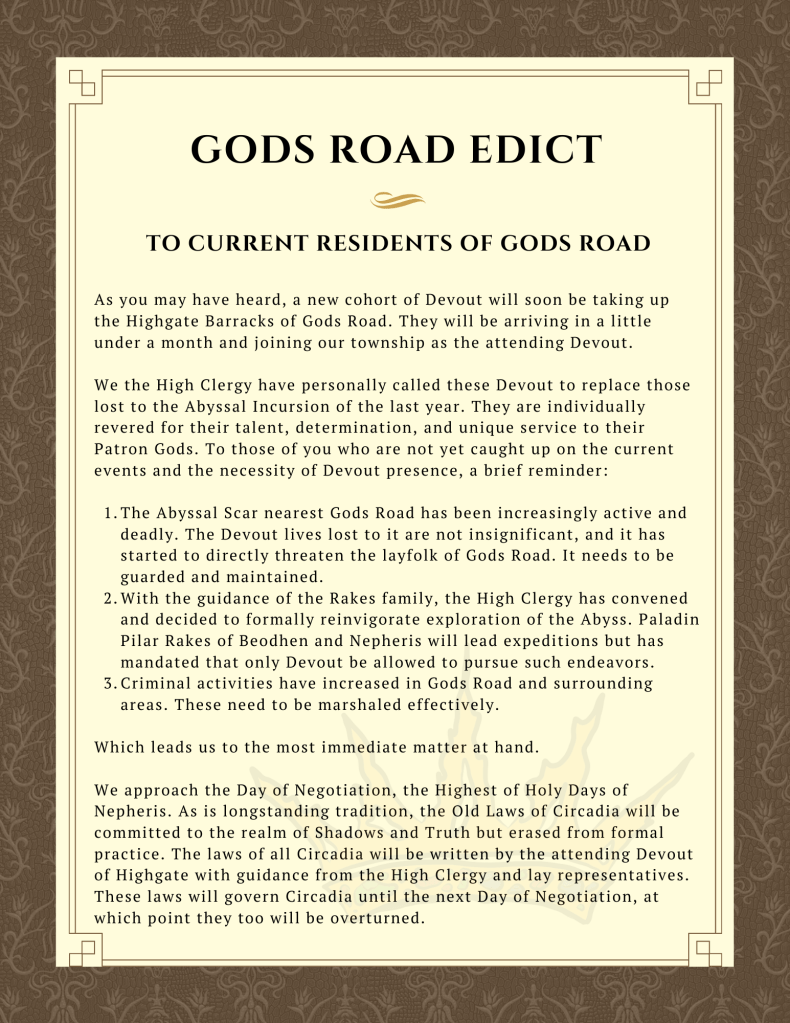
Gods Road Edict (full text)
To Current Residents of Gods Road:
As you may have heard, a new cohort of Devout will soon be taking up the Highgate Barracks of Gods Road. They will be arriving in a little under a month and joining our township as the attending Devout.
We the High Clergy have personally called these Devout to replace those lost to the Abyssal Incursion of the last year. They are individually revered for their talent, determination, and unique service to their Patron Gods. To those of you who are not yet caught up on the current events and the necessity of Devout presence, a brief reminder:
The Abyssal Scar nearest Gods Road has been increasingly active and deadly. The Devout lives lost to it are not insignificant, and it has started to directly threaten the layfolk of Gods Road. It needs to be guarded and maintained.
With the guidance of the Rakes family, the High Clergy has convened and decided to formally reinvigorate exploration of the Abyss. Paladin Pilar Rakes of Beodhen and Nepheris will lead expeditions but has mandated that only Devout be allowed to pursue such endeavors.
Criminal activities have increased in Gods Road and surrounding areas. These need to be marshaled effectively.
Which leads us to the most immediate matter at hand.
We approach the Day of Negotiation, the Highest of Holy Days of Nepheris. As is longstanding tradition, the Old Laws of Circadia will be committed to the realm of Shadows and Truth but erased from formal practice. The laws of all Circadia will be written by the attending Devout of Highgate with guidance from the High Clergy and lay representatives. These laws will govern Circadia until the next Day of Negotiation, at which point they too will be overturned.
This is both a great honor and burden. The attending Devout will need to come together to imagine how the legal proceedings of the next year will work.
This is an especially difficult responsibility for the Devout new to this area: indeed, the large influx of newcomers makes this a complex process. However, we the High Clergy will invite them to make their perspectives known, and we will ask them to invite a new year based on their experiences.
The current laws of Circadia have been in effect for decades, but they no longer serve our needs. We are soundly out of the Blood War, and new threats and opportunities emerge.
As always, we invite any layfolk interested in contributing their ideas to submit them in writing or by verbal report. Sébastien Silverschloss, the innkeeper of Highgate Barracks, will mediate your contributions.
Every non-heretical voice, Devout or not, will be heard.
The formal Negotiations will begin at the start of the 14th Day of the Tenth Month; they will continue until the dinner hours, at which point a representative will arrive to draft the proposed rules. Immediately at the end of the dinner hour, the rules will be read aloud and submitted for formal codification and circulation.
I trust you will offer this new group of Devout a warm welcome and the respect they are due. While they may be new to our area, they are seasoned veterans in many walks of life.
In Service,
The High Clergy
Petra Lionhardt, High Priestess of Beodhen
Myr’naianesa, High Priestess of Nepheris
Duncan of Fairchild, High Priest of Steramestei
Cyrus and Milot Aspera, High Priests of Kasamei
Sympathy Called Sincerity, High Priest of T’Zyri
Out of Game Announcements
Please register! We will start sending out individualized in-game materials in the next few weeks. We need your sign-up and character history to do so.
We would like people to start signing up for In-Game spaces that they will take responsibility for. I’ve heard specific interest from three players, but I’d like you all to formally sign-up.
As we discussed, we are providing the opportunity for PCs to earn CP by taking responsibility for a PC space in order to earn CP. Anyone involved in adopting a space will receive 1 CP per event they decorate the space. This CP does not count to your overall CP cap. (You can go over cap.)
Your responsibilities would include:
Setting up the space and cleaning it up at game-off.
Providing props. (One exception.)
Storing the props and bringing them to site. (We are flexible on this if storage and transport would prevent a person from adopting a space.)
PC Tavern Spaces
Table 1: Shrine to Beodhen, Open
Table 2: Shrine to Nepheris, Open
Table 3: Shrine to T’Zyri, Open
Table 4: Open Concept, Open
Table 5: Open Concept, Open
Other Spaces
Outdoor Pavilion: Shrine to the Sisters, Open (props are provides for this, including the pavilion; we will store this)
Mac’s Shack: Auxiliary PC space, Claimed
If you have other suggestions, we are open to hearing them. Multiple players will be welcome to collaborate on a space. We also know that some people who may be interested in setting up a space regularly may not be able to make it to game–we know life happens and will work with you should that arise.
On the Nature of Mana and Magic Magister Paxia T’Myra Keynote Address, Gods Road Symposium on Magic Magic in the Reconstruction Series, 534 Sela
The following notes are transcribed from the symposium address delivered by Magister T’Myra, Cleric of T’Zyri and High Mage of Myrim’lyr College, in the year 534 Sela.
Honored colleagues, it is a true pleasure to join you during this return to the annual Symposium on Magic at Gods Road. As a representative of Myrim’lyr College, the oldest institution of higher learning in Circadia, I hope this address can move all of us towards a progressive future dictated by our noble history. Additionally, as a lifetime follower of my lady T’Zyri, Keeper of Secrets, I feel especially honored to present such information in her name. Without further ado…
Magic has long been a subject of interest among both the Devout and the layfolk. Indeed, entire careers have been dedicated to understanding the Blessing bestowed upon us and its reverberation in our Mortal world.
While the Blood War remains a staunch tragedy in the minds of even the most stalwart, we cannot deny that in Hyrnedhna’s carnage, we learned much about Magic. However, it is easy to fixate on the immediate. In light of current political tensions, I wish to instead turn back to basics.
Since T’Myrim and Zyr’Zane graced Mortal soil, some form of Magic has existed among all worshippers. Indeed, the Age of Worship, when our various cultures came together in pursuit of the Old Gods, we learned quickly that those faithful among us can channel the Magical essence of this world. And, of course, when the first Pantheon of Faeris’lyr came to be, such Magic and the rise of the Devout coincided–as we now well know, to be Devout is to be a vessel of the Gods’ tremendous power. Mortals have never before seen the power provided by our current divine Pantheon.
Such matters, as you well know, are matters for historians. They are well documented in the Cloisters’ archives for any past-minded person to scour. However, I am no historian. I am a Mage.
And, so, back to basics.
Devotion. Attributes. Mana. Magic.
The combination that binds the Devout in service to all of Circadia and the Gods. Our gift, Blessing, and burden.
As a High Mage, I remind you of the best accepted theory on magic. The theory of Divine Mana Channeling.
As all Mages know, the world is infused with various forces: we understand them as the Four Corporeal Elements and the Ethereal Gift. Earth, Air, Water, Fire, and Caliber.
To be more descriptive: the stability and strength of Earth, the ever-rushing flow of Air, the sudden surges of Water, the Fire that can erupt at any moment, and the Caliber of your spirit. These elements are aligned with the world around us– capitalizing on that alignment through our faith is how greatness happens.
Enter Mana, the stuff of the Circadian landscape. The unseen carriers of such elemental power that exist beyond most Mortal perception. Even the most talented of Mages have yet to ethically distill Mana into its discreet parts for more than a few moments. Nevertheless, we know it is there.
Beyond this, we know we, the Devout, are able to channel Mana through our Devotion as manifested Attributes.
Prismatic Theory states that the role of the Pantheon is for the Gods to collect Mana and distribute it among their chosen Devout. The collection of an enormous pool of Mana manifests as a single Attribute–the Earth, Air, Fire, Water, and Caliber that represents our Divine power. We know that when we expend an attribute, it is eventually refreshed by the Divine power of our patron God or Gods. Such is the well-established relationship between Devotion, Attributes, and Mana.
To my first year undergraduates, I explain the process thusly.
Mana is the nearly intangible stuff that infuses Circadia; we can only see it in heavily controlled or awesome spaces, but research concludes it is unrefined elemental power. Our Pantheon Gods can collect huge amounts of this Mana and channel it into their Devout. This manifests as the Attributes we feel within ourselves. In other words, the Gods make the multitude of magical essence around us into something we can use. Small bits collected and made material within us.
As any Mage knows, as Devout Mages our Gods give us the power to channel raw Mana into spells. Since we cannot see the Mana, but we know it is there, it becomes our duty to reverse engineer our Magic–we master the tangible spell to corral the intangible Mana.
I study such things daily, and, still, such a reality captures me in wonder.
It bears reminding: as far as we know, the Devout are the only confirmed individuals with Attributes. Those who have walked or fallen from Devotion report they lose the sense of power and can no longer feel or use their Attributes. Lifelong layfolk report no manifestation of Attributes within them, even when they are experts in the study of Magic itself.
So, seemingly, that’s how Magic works. But it does not answer the question, what is Mana?
We still don’t know. I find that, as a scholar nearing retirement, a delightful opportunity for this generation of rising Mages.
In this era of massive change, we have new variables that expand our horizons.
To return to the Blood War.
Magister Rubius Rakes II’s study on magical re-entry suggested the veracity of many longheld theories. A lay follower of Nepheris, Magister Rakes was given permission to enter the battlefields as a neutral party during the Blood War. His sole task was to observe and record seeming changes in Magical manifestation. Of course, when a God was on the field, the Devout were more powerful, finding themselves gifted with temporary Attributes and even new abilities.
But something more troubling arose. The reality of death that bore the fruit of the Rubius Law: Mana seems momentarily perceptible, by Mortals, during times of great death.
In the Battle of Beasts, when Hyrnedhna and Beodhen took the field with their forces, over 3000 Mortals, including Hyrnedhnai, perished. All survivors, including Magister Rakes, witnessed thousands of multicolored orbs floating around the field. In a well told tale, Beodhen won this battle because he was able to quickly seize the power of many of these orbs and channel them into his Clerics. The Clerics restored to life roughly 300 of his mightiest Paladins, and they took the field. Hyrnedhna retreated.
More troubling still is the earlier death of Mynair. Magister Rakes, having witnessed the Battle of Beasts, looked for the survivors who had withstood Hyrnedhna’s raid on the coast. High Priestess Myr’naianesa, chosen of Mynair and now Mortal Consort to and High Priestess of Nepheris, reports that when Mynair fell, the Tides swelled with millions of blue orbs. Such orbs fell upon the Mynaira before disappearing. While neither High Priestess Myr’naianesa or Magister Rakes can truly confirm it, it seems that the death of a God resulted in an exponential version of the phenomenon witnessed at the Battle of Beasts.
And what do we make of all this? Our theorem remains seemingly true but perhaps comparatively insignificant when we muse at that still unknown.
To conclude, I pose a perhaps strange direction: interdisciplinary studies.
Those who have studied witchcraft and even those who have observed Magicians have long waited in the shadows of academic halls. This seems unfair: to understand Heresy, one must study Heretics. These scholars, our proper colleagues, have risked life and limbs to observe the doings of Heretics. Yet we cast them aside.
As a Devout of T’Zyri, I suggest we welcome our colleagues made outcast by our own outdated academic cultures. It seems intellectually lazy to resist the knowledge of other students of the world.
And so.
As High Mage of Myrim’lyr College, I hearby establish the first ever accredited Department for the Social Study of Heretical and Abyssal Magic, hosted by Myrim’lyr College. The esteemed Magister Devon Rakes, lay follower of Nepheris, has agreed to sign on as the first Chair of the Department.
Some are busy worshipping the Gods. We are busy writing about them.
– Magister Pyrvain, The Cloisters at T’Gyr
The Cloisters at T’Gyr
The world of Circadia is an old one, and the histories span thousands of years of interaction between the Mortals and the Gods. Luckily, an order of archivists, The Magisters, has committed to assembling important accounts in The Cloisters at T’gyr. While often imperfect and frequently biased, these accounts are the most comprehensive histories of Circadia.
In Zealot, much of the in-game information, particularly teasers and background lore, will come in the form of these accounts. All players should assume ready access to these history books but should know that the writers may have had their own biases in the writing of the accounts.
An account of how Myr’naianesa of na’Malriel became the High Priestess of Nepheris. Mention of the Red Spring family.
From the Reconstruction Archive, 532 Sela
Documented by Magister Tyrus, TheCloistersat T’gyr.
As is known, the Blood War shifted Mortal and Godly allegiances considerably, though much of this shifting was done under the consequences of the war itself. Afterall, pressure from victorious forces hardly aligns with genuine disavowal of a long-held faith and much more closely parallels the necessities of failure. The reorganization of The Pantheon, of course, expedited declarations of “new” faith, and even Fallen Gods generally understood the defection of followers.
Nonetheless, there were Devout who genuinely found new faith during and after the Blood War. These accounts are held as testament to the Power of the Devout and, in matters of faith, the helplessness of Gods.
One account involves the controversial Red Spring family.
Hyrnedhna’s Red Spring
Prior to the Blood War, the Red Spring clan were ardent followers of Hyrnedhna. Oral traditions generally claim they had followed the Goddess since her ascension some 200 years ago. Indeed, the historical Red Spring matriarch, Deirdre Red Spring of Connath, is said to be the first Devout of Hyrnedhna who grew claws and antlers, marking her considerable place in the Goddess’s esteem.
While not all Devout of Hyrnedhna have been warlike, certainly, the Red Spring clan set the gold standard for warriors of the Goddess. Nearly every Red Spring (of note) has been a Paladin, and, during early skirmishes with The Corruption of the Abyss, they were among the most fearsome.
All to say, it was unsurprising that, on the advent of The Blood War, they mounted mighty force in support of Hyrnedhna. When the Goddess raised up arms against Mynair, they were certainly among the number making move against the Sea Maiden and her creatures. While it is unknown if they were present for the slaughter of Mynair, it is certain they were on the regular field of battle. And, indeed, when Beodhen declared singular war against Hyrnedhna, they marched at her side. Most impressive given that some of the Red Spring were but mere teenagers during the Blood War.
However, the Red Spring clan underwent a true change of Faith during the war. The specific event precipitating this is unclear, however it coincided with the incidental Mortal casualties caused by Hyrnedhna’s campaign. While Beodhen, then the Prince of Beasts, may not have spared too much thought for such losses (it cannot truly be said), the protection of his (self-proclaimed neutral) loyalists–Nepheris, Kasamei, and Steramestei–offered protection to those civilians in contested territories. Seeing the casual bloodshed caused by Hyrnedhna, who has only ever allied herself with the natural world, the Red Spring family in its entirety denounced the Goddess and defected to Beodhen’s side.
The Red Springs’ Choice & Hrynedhna’s Wrath
While this defection came as a surprise to many engulfed in the heat of the violence, those aware of the Red Spring leaders were sympathetic: the Red Springs had long served as the intermediaries between Hyrnedhna and the common folk. Their role, historically, had been to empathize with Mortals and, as Hyrnedhna’s Devout, ask the Goddess to consider how her actions might impact them. This was especially important when Hyrnedhna’s creatures–the Hyrnedhnai–threatened the livelihood of Mortals.
As the Blood War raged, Hyrnedhna spared the defectors no mercy: of the thirty or so Red Spring family members involved in the war, at least a dozen were killed by Hyrnedhna personally. However, the Red Springs fought ferociously for Beodhen and were the key combatants in a number of decisive battles. When the war ended and Beodhen emerged victorious, he offered the Red Spring family his highest Blessing and immediately welcomed them into his Court.
The Red Springs remain powerful today, and it is widely supposed that Vanya Red Spring, a daughter of the patriarch Alexei, would have been promoted as Beodhen’s High Priestess and Mortal Consort, but her ascension was blocked by the Lionhardt family in favor of their own (and decidedly platonic) line.
Such is a story of genuine change of Faith catalyzed by the Blood War and, more specifically, the actions of a God failing the Devotion of a Mortal. In this case, the change resulted in considerable new power given to Beodhen by Mortal Devout.
The case of Myr’naianesa, High Priestess of Nepheris and Mynair, is a bit stranger.
Myr’naianesa, Beloved of Mynair
Myrna, as she is commonly called, is a well-known and well-regarded lifetime follower of Mynair. In fact, prior to the goddess’s death, Mynair, the Sea Goddess, favored no Mortal more than she did Myrna–Myrna’s formal name, Myr’naianesa, is an old Circadian name, bestowed to her by Mynair, that means “beloved of the seas.” While Mynair lived, Myrna served as her constant companion, and it is said that she was told secrets kept from even Beodhen himself.
For this reason, after Mynair was slain, it was assumed that Myrna would announce her allegiance to Beodhen. As Mynair’s attendant, Myrna had long been a presence in Beodhen’s court and was roundly liked by followers of Mynair, Beodhen, and their allies. After Mynair’s death, and during the war itself, Myrna went into hiding with many of the surviving Mynaira. Myrna was not even present when Kasamei presented Mynair’s corpse to Beodhen. It is unknown what Myrna did during the war, but generally assumed that she was secreting away precious artifacts Mynair had left behind.
However, when the Blood War ended Myrna was invited warmly to Beodhen’s hall. A lavish but solemn feast was held in Mynair’s memory, and Myrna and some ranking Mynaira were the guests of honor. At this point, Beodhen had already claimed and offered Blessing to most Mynair Devout and Mynaira. They had, in turn, thankfully accepted his Blessing. Towards the end of the formal toasts, Beodhen made a grand announcement: he asked Myrna, as the former High Priestess of Mynair, to accept his Blessing and join him as High Priestess of Beodhen. He assured her that, as High Priestess of Beodhen, he would allow her to serve as High Priestess of Mynair simultaneously–a ranking High Priestess of a former God was something no Pantheon leader had ever formally condoned, and the offer marked Beodhen as more ecumenical than his predecessors. Most of the banquet guests looked on eagerly and applauded Beodhen.
One guest, Beodhen’s brother, the God Nepheris, maintained a neutral expression. Nepheris had in fact suggested the match to his brother: Myrna as High Priestess, allowed to serve both the Pantheon and a Fallen God, would set a precedent that might cool the tempers of Devout whose Gods had been displaced during the Blood War. Set on the romantic backdrop of Beodhen and Mynair’s relationship, it seemed, Nepheris mused, ideal.
Myr’naianesa’s Startling Reply
Myrna, however, shocked the feast’s attendees. Politely, she refused the Blessing of Beodhen: she stated that, even if Beodhen’s wartime passions were true, she doubted the integrity of his ascension to the head of the Pantheon. It is said that even mild-mannered Kasamei gasped (while Steramestei laughed), as Myrna explained that her Devotion would always be primarily to Mynair and the Mortals Mynair so loved.
As Beodhen started to fly into a rage, Myrna then turned to the Prince of Contracts and publicly committed herself to Nepheris. She announced that, while she would maintain her Devotion to Mynair, she would commit herself to a God on the Pantheon as, she concluded, all those still worshiping a Fallen God ought do. It is hard to tell if Nepheris was surprised or merely pleased, but he immediately designated Myrna as his High Priestess (simultaneously, and generously, retiring the ancient Odipos Rakes). Even Steramestei and Verine, enjoying the show, were speechless.
Of course, Nepheris and High Priestess Myr’naianesa set an important precedent for worship in the Reconstruction: their union is one that has certainly normalized not only worship of Fallen Gods (though it remains mild heresy) but also the political power of High Priests of these Gods. Even Beodhen, who has remained adversarial towards Myrna and her public embarrassment of him, begrudgingly admits that they are to credit with the post-war conversion of many Devout.
Along with the defection of the Red Spring family, Myrna’s story remains a significant bit of Blood War history. It has, of course, inspired many artists, and there are more images and poems of Myrna than any other current High Priest. While romantics claim her action was done out of a long hidden love for the God Nepheris, shrewder Devout suspect that her allegiance was hewn from a standing scheme concocted with Nepheris–the impetus behind such a strategy remains a mystery.
Myr’naianesa’s exact role in Nepheris’s life is now subject to much speculation, but, when he alights, she lives in residence with him, and they have been openly affectionate with one another. She has taken no Mortal companions.
Glossary:
Alexei Red Spring– Patriarch of the Red Spring family, Alexei died during the Blood War, by Hyrnedhna’s hand.
Beodhen– the King of Beasts who deposed the former King of the Gods, T’rer, and defeated Hyrnedhna during The Blood War.
The Blood War– The major war of the current age. The Blood War resulted in the upheaval of The Pantheon: Hyrnedhna’s murder of Mynair resulted in the start of the War and the eventual ascension of Behoden and T’zyri.
Deirdre Red Spring of Connath– The first Matriarch of the Red Springs, Deirdre is a near legendary figure who popularized worship of Hyrnedhna. Connath, her birth place, maintains a memorial to her.
The Fallen Gods– Gods who once were on The Pantheon and, for whatever reason, were removed from it. There are many Fallen Gods, but very few are still recognized by worshippers. Currently, only Hyrnedhna, Mynair, Gu’labir, Opix, Verine, and T’rer are recognized Fallen Gods.
High Priest– A God’s most stalwart advisor and leader of their Mortal assembly of Devout and layfolk alike. There is only one High Priest per God.
Hyrnedhna– Wild Goddess of Nature’s untamed aspects. A Fallen God.
Hyrnedhnai– Hyrnedhna’s creatures and beastfolk that blur the boundaries of human and non-human. They live outside of Mortal civilization.
Lionhardt– A longstanding Great Family in service to Beodhen.
Mortal Consort–Closest ally to a God, oftentimes a lover or lefthand chosen from the ranks of Mortals. A Mortal Consort may or may not be a High Priest.
Mynair– The Goddess of the Waters, slain by Hyrnedhna in a bloody campaign that ravaged Circadia.
Myr’naianesa– the High Priestess of Mynair that now also serves as Nepheris’s High Priestess after she spurned Beodhen.
Nepheris- The God of Contracts, bound to facilitate both the Pantheon and the Mortal World, brother to Beodhen and nephew of Verine.
The Pantheon– The ranking Gods whom Mortals worship, The Pantheon controls Divine Power. The structure of the Pantheon shifts every few hundred years or so.
Red Spring– A longstanding family of Devout formerly in service to Hyrnedhna, now among the foremost followers of Beodhen.
Vanya Red Spring– High ranking Devout of Beodhen and daughter of the Red Spring Patriarch, Alexei.


 Zealot Larp